Biography
Early Life
Lillian Hyman was born in New Orleans in 1896. Her mother and father, Clara Newman and Harris Hyman, were from well-established Southern Jewish families, with long histories in business and strong local identities.
She grew up in New Orleans in a large house on St. Charles Avenue, complete with much family, supported in a high standard of living by staff. Later in life, she described the putting away of curtains and carpets for the summer, due to the thick southern heat. Like many Jewish families from the Midwest, her family went north to summer in Charlevoix, Michigan.
The second daughter of three, Lillian was preceded by her sister Nettie, and followed by her brother Harris Hyman Jr., and later her younger sister Claire. Lillian had a good voice, with an interest in opera singing. A good scholar, she went away to Smith College, and did well, enjoying literature and philosophy.
In 1918 at 22, having just finished college, she married a young Navy officer, Irving Florsheim, from Chicago whom she met in Charlevoix. He was from a prominent Chicago manufacturing company (Florsheim Shoes), founded by his grandfather, and run by the family. After his military service was complete, Irving and Lillian moved to Chicago and kept homes in both the city and the country, with Red Top Farm (purchased from the Insull family) in Libertyville, near other prominent Chicago families.
Initially, Lillian tried a role of the proper tending wife, but her spirited ways were not at ease with the more traditional expectations of her husband. He was from a notable German Jewish family in Chicago, involved in both business and civic affairs. He served on the board of the city’s largest bank, was head of a synagogue board for Temple Sholom, and with his brother, Harold, ran the Florsheim Shoe Company.
Lillian once recalled shopping for a birthday present for Harold Florsheim, in Katherine Kuh’s art gallery. She brought home several Paul Klee paintings from which Irving was to chose. She recalled bitterly how he rejected them all, told her to take them back and get something silver instead.
Lillian and Irving had two children early in their marriage, Mary and Nancy. Both were bright and especially independently minded. Mary’s relationship with her father was tempestuous, and she settled in southern California. Nancy, went east to Smith College, and came back to Chicago and wanted to join her father in business, an idea he did not accept.
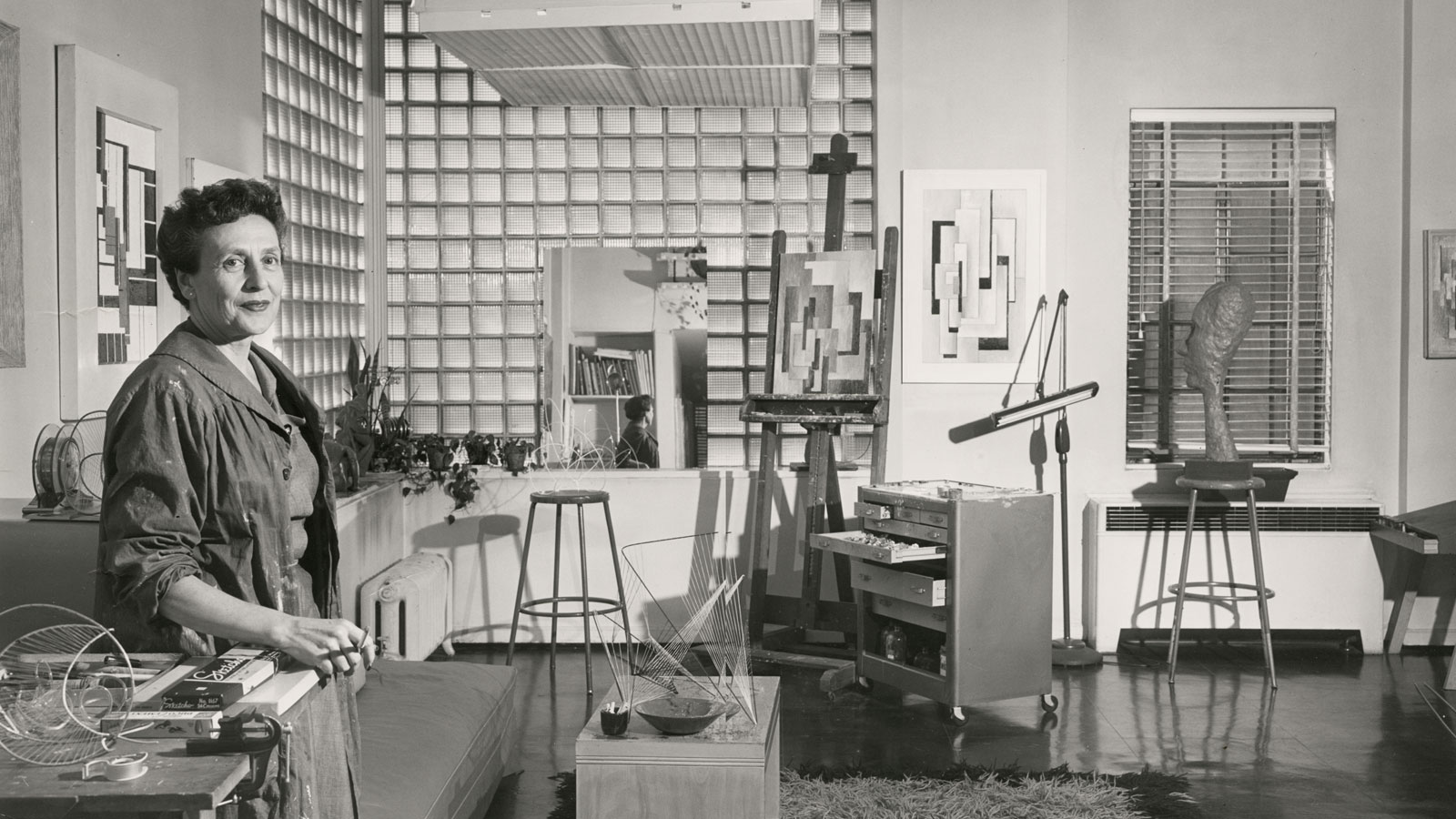
Lillian divorced in early 1946 after 28 years of marriage. Looking for a new place to live with her daughter Nancy, they found a small property at 1328 State Street. With two small houses, Lillian would live in the front and Nancy would take the back. By the end of year, Lillian was in her new house, but Nancy’s plans had changed. In December of that year, she and Bertrand Goldberg were married in a small ceremony on the first floor of Lillian’s new home.
Never remarried, Lillian remained close with her grandchildren and her older New Orleans family. In 1927, New Orleans was threatened with a flood and her sister Nettie Lemann sent her young child, Tommy, to stay with Lillian, the beginning a long and fond relationship. He and his younger brother Steven remained close with Lillian: these southern cousins sent barrels of oysters for holiday parties, and came north for Lillian's birthdays, giving toasts in well-constructed English meter, dressed in cutaway and top hats.
Lillian was known throughout her life for her elegance, poise, and thoughtfulness. Sensitive to the plight of others, she spent time during the War raising money to get Jews out of Germany, even though not religiously inclined herself. She frequently stated one should vote for what is right, not one’s pocketbook or self-interest. Living a comfortable life, she had little interest in flippant conversation, preferring to discuss politics or culture. Active in the upper echelons of Chicago society, she was well read and traveled frequently. At age 82, She wrote her thoughts about her upbringing in a small booklet “Memories of a Distant Youth”, which she shared with her family.
Her Art
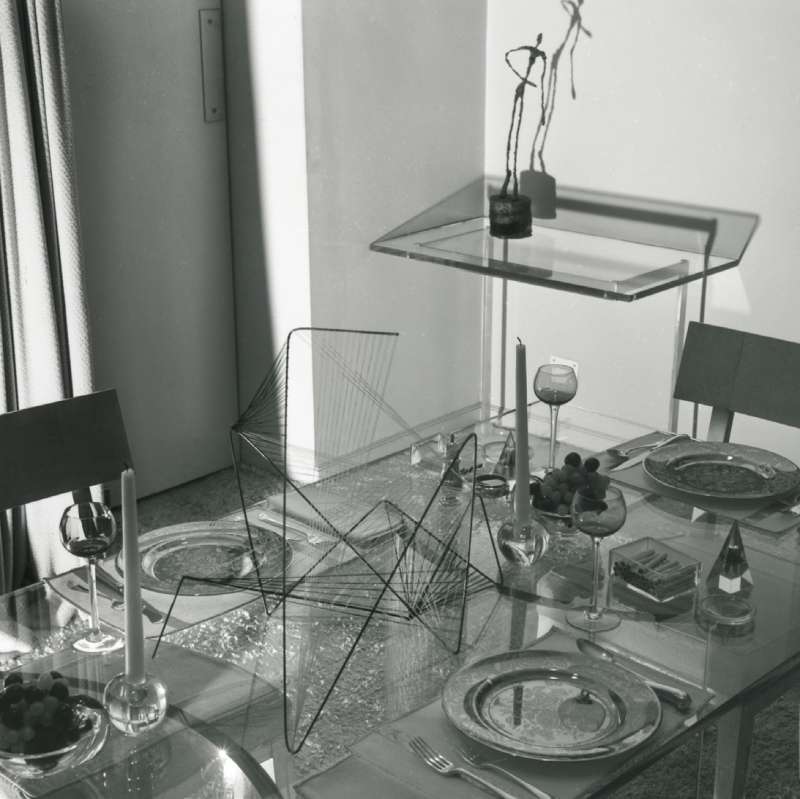
Art studies began in the late 1940s in her fifties, painting with Rudolph Wiesenborn and George Buehle, both in Chicago. At that time, she also began sculpturing. Seeing a Max Bill work at the Art Institute in 1950, she became interested in more abstract work, and started studies with Hugo Weber at the Institute of Design. There she was introduced to more exploratory abstractions and three-dimensional studies with string wrapped over wire armatures, a technique derived from Moholy-Nagy’s early teachings and taught at ID. Through the 1950s, Lillian worked unaccompanied at home, making abstracted figures and string study models. She also made utilitarian objects in Plexiglas, marketing a series of cigarette lighters called “Li-lites”. A variety of materials were used, including plaster, wax for bronze castings, and Plexiglas.
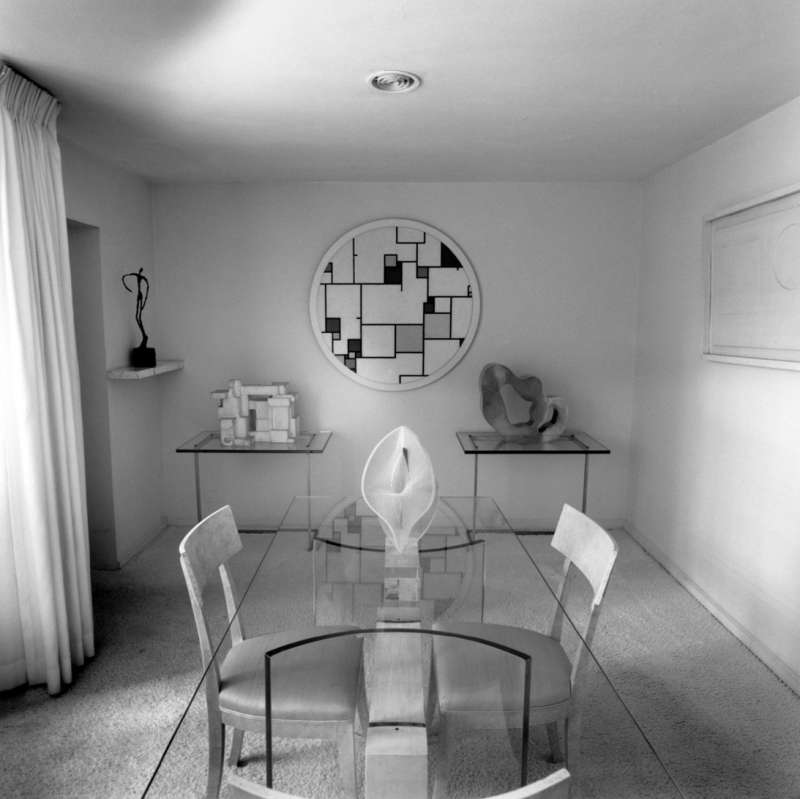
In the early 1960s, her work changed, her sculptures became more abstract and complex studies of pure form, building on the work of Arp and Max Bill she had begun to acquire. She started plaster work in the 1950s, sometimes casting the works in metal, up Her string studies became more formal, inspired by her 1959 acquisition of a Gabo piece, displayed on the center of her dining table. By the mid 1960s, Plexiglas work took root, first layered to make form, then reconsidered and developing into strong geometric constructions of rods and planes. This latter approach was one to which she remained dedicated for most of her work.
By the late 1960s, the pieces became much larger, first as tall columns and plinths, and later as assemblies of tubes and portals, culminating with her significant show at the Museum of Contemporary Art in Chicago in 1970. After this watershed, she paused for a few years. When she restarted, the focus was on smaller more intimate pieces.
Art Collection
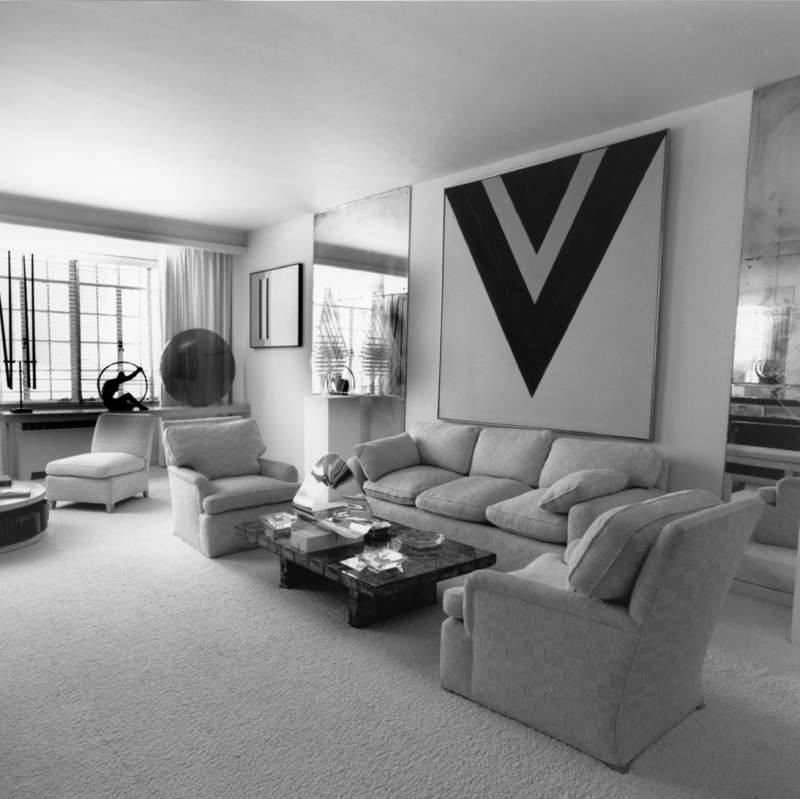
Lillian began to collect art in the 1950s and built a significant and well-considered collection over the next two decades. Her interests ranged from early cubist works to more current geometric explorations even into the 1970s. She was known for her very acute eye in judging artwork.Starting int he 1950s, she worked for several years to build a friendship with Georges Vantongerloo, a Belgian artist, former member of De Stijl and who had headed the artists' group Abstraction-Creation during the 1930s. She visited him yearly in Paris, and acquired a number of his works. Their warm correspondence continued into 1960s.
She knew many of the artists whose work she acquired. Her collection included works by Barbara Hepworth, Naum Gabo, Sonia and Robert Delaunay, Jean Arp, and Isamu Noguchi, and was shown several times in public settings, including an early showing at Smith College in the 1960s. Her willingness to show the collection continued through the next two decades, although this caused some confusion for her own identity as an artist. The combination of collector and artist was one not easily reconciled during the turbulent 1960s and 1970s. This period of social unrest was not optimal for one interested in conceptual explorations of geometry in formal constructions. While Lillian saw her collection as a continuum of her own thinking about certain aesthetic issues, others were more impressed by the quality of the collection and not so much with the artist-as-patron.
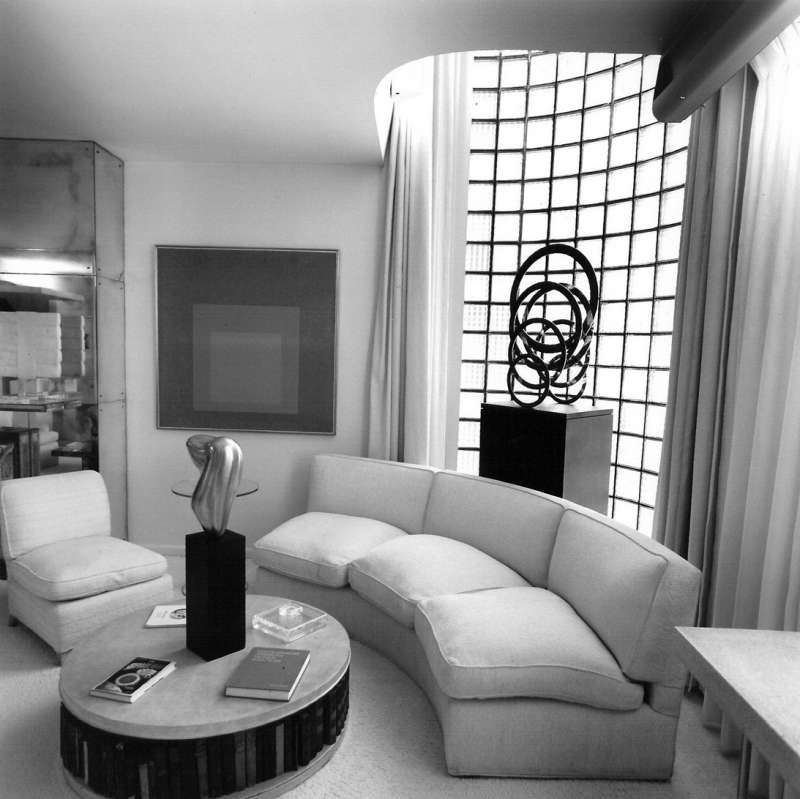
Denise René was one person able to reach over those gaps. A leading Parisian gallerist, René had been active in the French modern art scene since opening her gallery with Vasarely in the late 1940s. A good friend, René hosted several one-person shows for Lillian in Paris, first in 1968 and then in 1969. She would visit Lillian and stay with her in Chicago. Much of Lillian’s collection included work by members of Abstraction-Creation , a group of avant-garde artists from the 1930s and a particular interest of René's. Both were also interested in current explorations, considering new artists from South America and elsewhere. Lillian also bought several works of Victor Vasarely, a good friend of Denise’s, and installed a glass piece of his in a window in her house.
Lillian and Bertrand
Lillian and her son-in-law, Bertrand Goldberg, began a fruitful collaboration after his marriage to her daughter Nancy in 1946. Bertrand started renovating Lillian’s home, helping to display her art, and designed her studio space. He designed a new kitchen for her as a bridge to join the two small buildings, hung inventively from a minimal structure. Lillian asked that it be elegant, using only white, black or silver, which he happily obliged.
In 1955, Nancy and Bertrand moved just a few blocks from Lillian’s home. Holiday dinners were often held at her house, and relationships were warm. Visits from family were frequent, as her grandchildren would join Lillian in her studio in the afternoons after school. Contact was frequent.
Bertrand encouraged his mother-in-law’s interest in the arts. He photographed her artworks and her collection, and helped install her shows. They both shared an interest in material explorations. Likely emboldened by Bertrand’s use of fiberglass for cladding her kitchen, Lillian studied new materials, working in plaster and casting techniques before Plexiglas. Her studio evolved into a complete fabrication arrangement in the early 1960s, as Bertrand equipped it with all its machinery, including a table saw, drill press, and polishing tools.
Bertrand and Lillian exchanged elegantly wrapped presents over the holidays, each wrapping a new composition. His were graphic patterns of lines, done in color with thin drafting tape from his office. Hers were more complex compositions. One was similar to an Alber's painting, and Bertrand displayed at his home, nearby one of Lillian’s sculptures.
Art and Architecture
Lillian’s artwork and Bertrand’s architecture share significant overlap in their formal agendas. By the early 1960s, both were exploring curved three-dimensional form. Lillian worked with string models, a technique learned at ID in the early 1950s, and she continued to work with strings into the mid-1960s.
Parallel to this was her work with abstract sculptures. Beginning with figural examples, from the late 1940s through the 1950s, she used Giacometti-like exaggerations of proportions. With interest in the work of Vantongerloo and Max Bill, her work became more abstract, and by the early 1960s, her sculptural works had significant abstraction and complexity.
Bertrand’s interest in curvature started with his furniture done largely in the 1950s. The first emergence of three-dimensional curved forms can be seen at Marina City, in particular at towers’ balconies and in some of the detailing of both the office and theater buildings. Possibly his richest example was at Brenneman School done at about the same time, with his use of hyperbolic concrete shells for each of 24 classrooms.
Curved shapes at Marina City look very similar to Lillian’s sculptures of that time, and drawings from the architectural office are very close to Lillian’s work with strings.
Lillian’s cast plaster works done in the early 1960s have a relationship to Bertrand’s architectural explorations of form. For instance, Quatrefoil, done in 1963- 64, presages the quatrefoil plans of Bertrand’s hospitals, which emerged a few years later; the volumetric expression in her piece can be seen as an underpinning for the “cantilevered shell from a core” idea of Prentice. However, after, the work of the two diverged. He continued to explore structural form, while she moved to compositions of Plexiglas rods, more regular and straightforward in construction. For her, geometry was key, through the structure of her explorations. One might think of her work as thoughtful, oriented to inquiry and investigation. For him, form, tectonics, structure, and program were the solution, organic and flowing together, yet with gravitas.
Bertrand and Lillian were both interested in composition and geometry, exploring centripetal and centrifugal arrangements. For a time, their interests overlapped, in a way that was fruitful for both. But in the end, each worked in their own discipline and, their processes and conclusions distinctly different.
Later Life
Lillian’s artistic career blossomed in the 1960s, with many shows in the US and overseas. Much of her support was from friends, with quiet respect from critics, who praised the discipline and elegance of the work. While the works were admired, the overall direction of her inquiry was not readily grasped at the time. By the late 1960s her work became more stylized, with Rods and Planes in a variety of sizes. She began to push beyond this in the early 1970s, working with oversized portals and tube assemblies.
The complexity of those constructions was significantly greater than her earlier work, and she had difficulties with the large MCA show in 1970. She stopped work for a number of years, and then at age 75, changed her focus to miniatures and assemblies of shards and shapes. She had several shows in the early 1980s of her new work. She passed away in December of 1988 at 92 years of age.